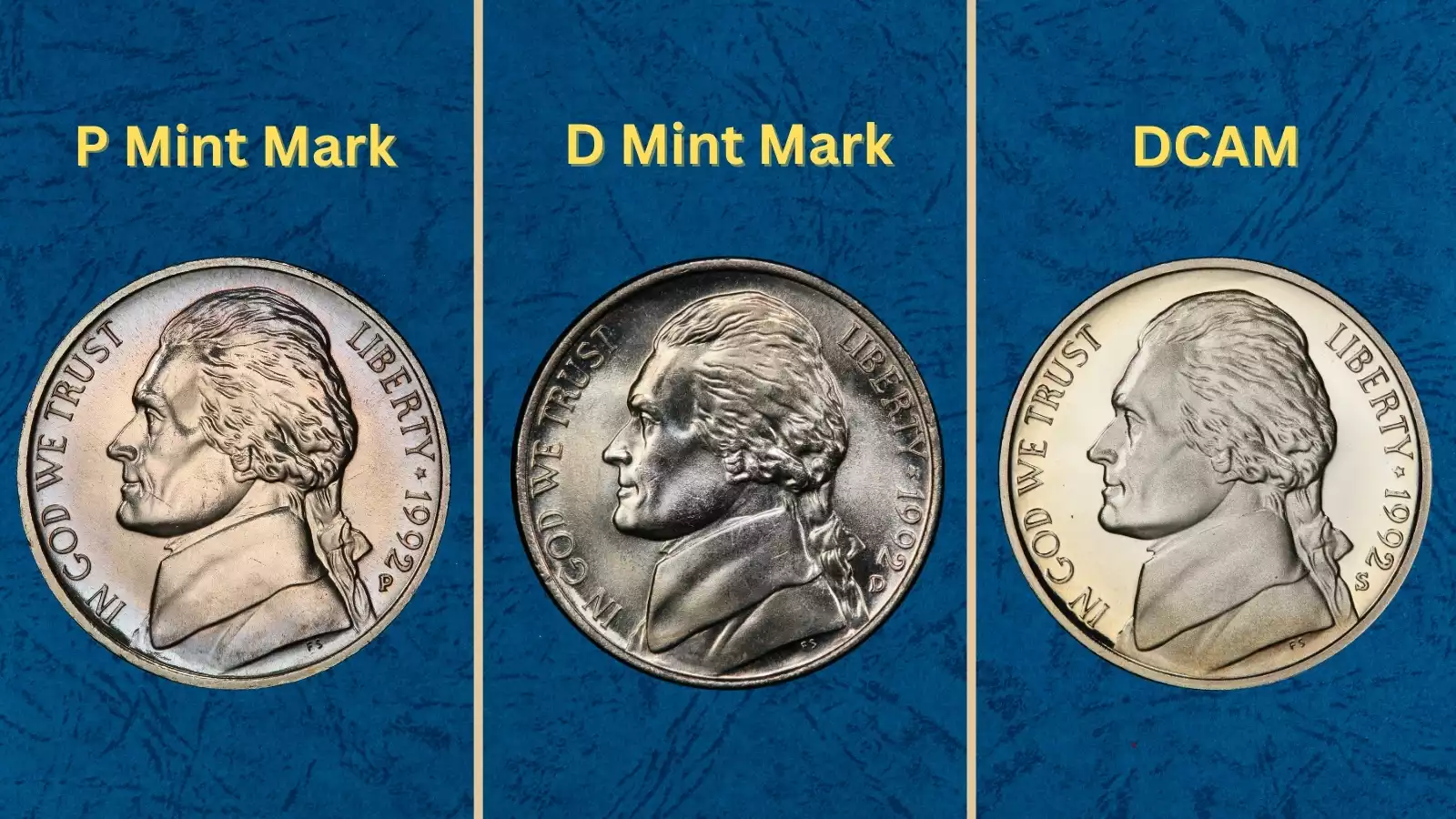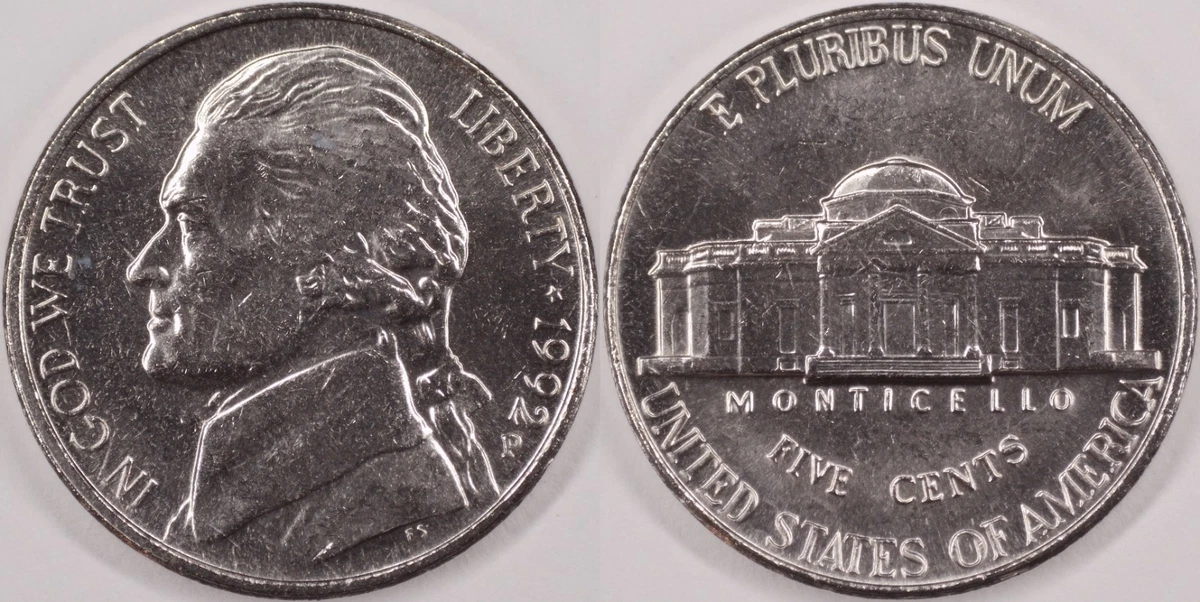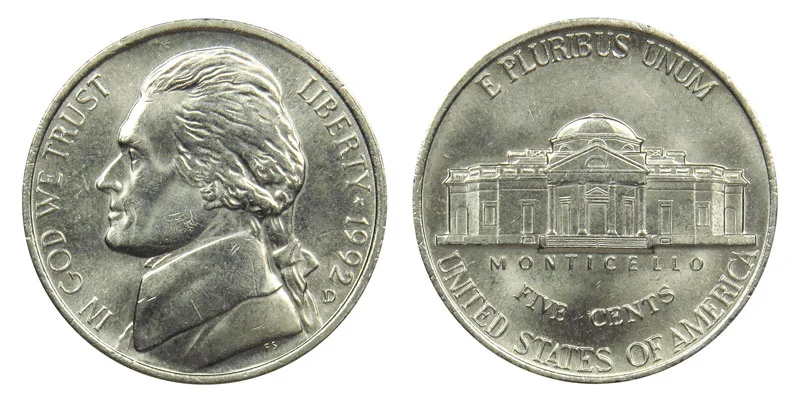
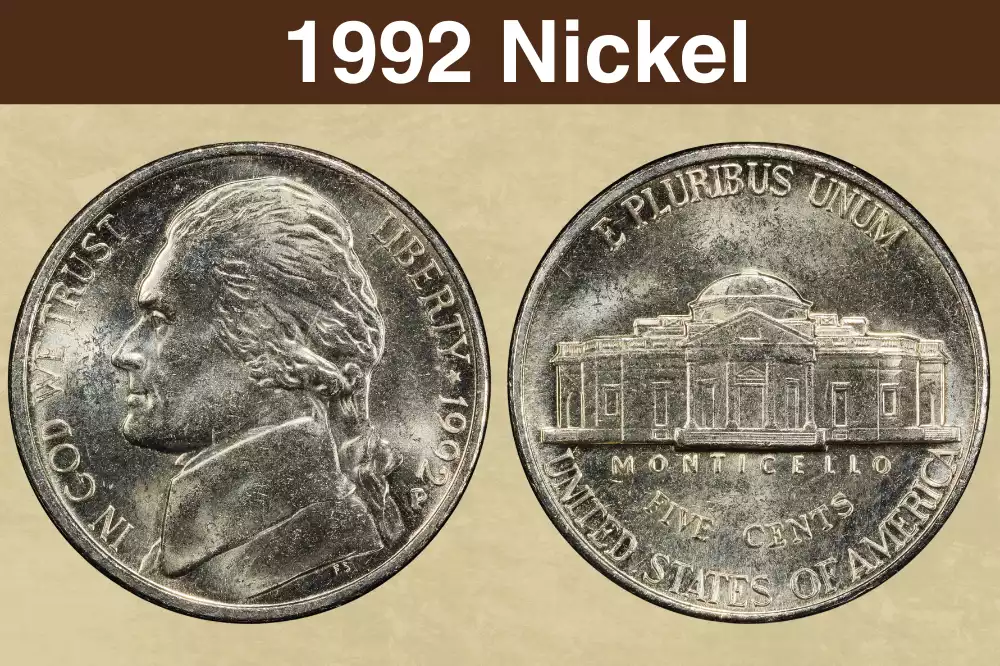
A single 1992-D nickel — graded MS67 Full Steps — sold for $3,760 at Heritage Auctions in January 2016. Most 1992 nickels in your pocket are worth face value, but the right combination of mint mark, strike quality, and error variety can transform a 5-cent coin into a three- or four-figure collectible. This guide covers every variable that matters.
Understanding why certain 1992 nickels are worth dramatically more than others starts with the Full Steps designation. For a thorough step-by-step 1992 nickel identification breakdown with photos, the full guide covers every grade tier in detail. The table below summarizes key value ranges by variety and condition. Highlight rows: gold = Full Steps signature variety; red = rarest error variety.
| Variety | Worn / Circ | Uncirculated (MS60–65) | Gem+ (MS66) | Top Grade |
|---|---|---|---|---|
| 1992-P Regular | Face value | $1.88 – $5.40 | ~$6 – $35 | MS67 ~$140 |
| ⭐ 1992-P Full Steps | N/A (FS requires MS) | $11 – $16 | $38 – $84 | MS67 FS $1,725 |
| 1992-D Regular | Face value | $1.60 – $3.80 | ~$6 – $37 | MS67 ~$192 |
| ⭐ 1992-D Full Steps | N/A (FS requires MS) | $13 – $16 | $38 – $84 | MS67 FS $3,760 |
| 1992-S Proof (DCAM) | N/A (proof only) | $2 – $4.78 (PR65–69) | $4 – $10 | PR70 DCAM ~$940 |
| 🔴 DDR Error | $25 – $50 | $50 – $150+ | $150+ | Varies by severity |
| Off-Center Strike | $30 – $75 | $75 – $300+ | $300+ | 50%+ off-center: $300 |
🪙 CoinHix lets you photograph your 1992 nickel and instantly cross-reference its grade tier against current market prices — a coin identifier and value app.
The U.S. Mint produced hundreds of millions of 1992 Jefferson nickels at high speed — and that pace creates errors. Each of the varieties below was confirmed through die, planchet, or strike failures and can add meaningful premiums over face value when properly authenticated. Learn to identify each one before you spend that nickel in your pocket.
The doubled die reverse on 1992 Jefferson nickels occurs when the working die receives two or more hub impressions at slightly different rotational or lateral positions during the hubbing process. Each impression lays a ghosted copy of the design slightly offset from the primary image, resulting in a coin that appears to show duplicate design elements when examined.
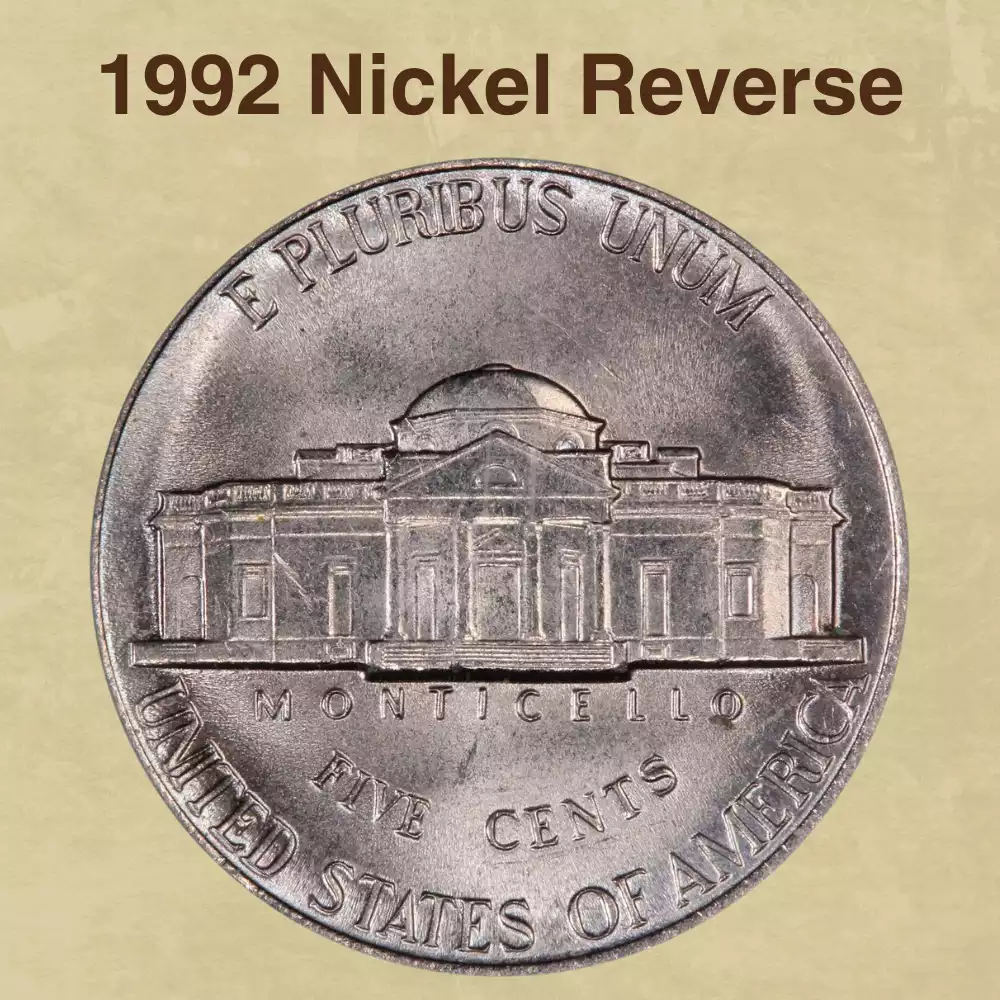
On 1992 DDR nickels, the doubling is most visible on the reverse lettering — particularly "MONTICELLO," "FIVE CENTS," and "E PLURIBUS UNUM." Under a 10× loupe, look for distinct, separated design outlines rather than the flat, shelf-like appearance of mechanical doubling (which adds no value). The architectural steps at the base of Monticello may also show slight separation.
Collectors actively seek confirmed 1992 DDR examples because the 1992 Jefferson nickel is listed as a known DDR variety in major reference catalogs including CONECA. Authenticated Mint State examples command the highest premiums, as the doubling is most legible on coins without surface wear. Worn pieces still bring a small premium over a common circulated nickel when clearly attributable.
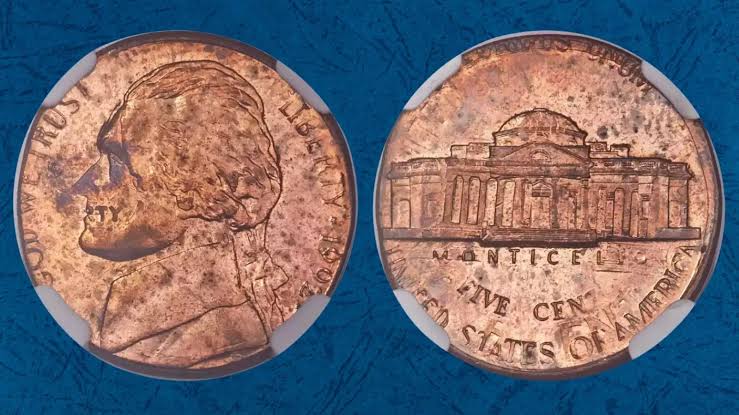
A double denomination error is among the most dramatic and valuable planchet mistakes a U.S. Mint can produce. It occurs when a struck coin (in this case, a cent) accidentally feeds back into a different denomination's press and receives a second strike — this time with a nickel die — resulting in a coin displaying elements of both denominations simultaneously.
On a 1992 double denomination nickel, close examination reveals remnants of the Lincoln cent design beneath the Jefferson nickel imagery. The planchet size discrepancy (a cent is 19.05 mm, a nickel is 21.2 mm) means the underlying cent design may be partially visible around the edges, and the coin's weight deviates from the standard 5.00 grams. This physical evidence makes authentication straightforward for professional graders.
This variety is the single most valuable confirmed 1992 nickel error type. A documented 1992 double denomination example sold at auction in 2011 for $1,265 — a remarkable sum for a coin with a face value of 5 cents. The dramatic visual impact and extreme rarity of double denomination pieces make them trophy coins for error collectors who specialize in major mint mistakes.
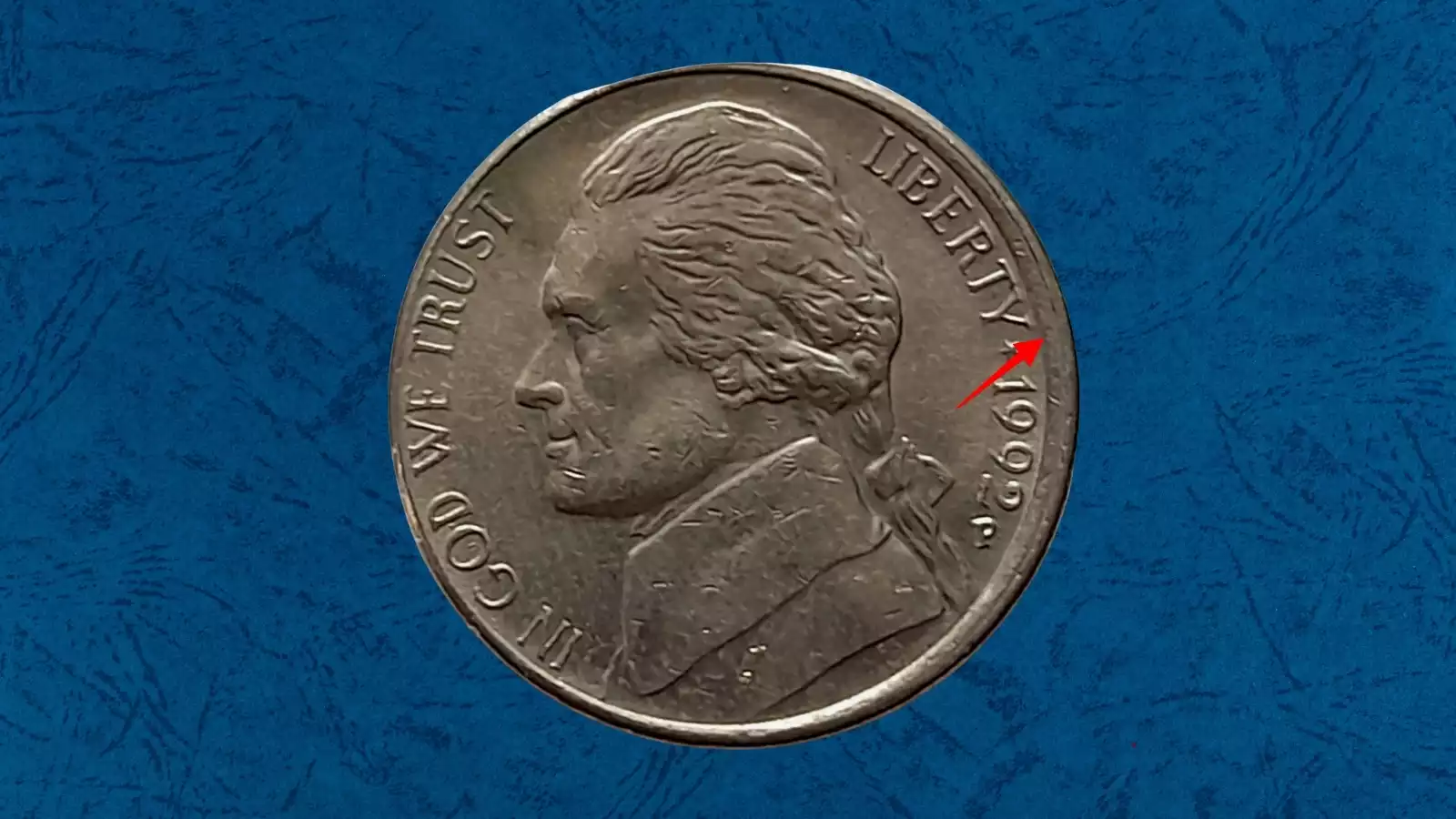
An off-center strike occurs when a planchet enters the coining chamber misaligned relative to the dies, so the dies contact only a portion of the planchet's surface. The struck area receives a complete, normal impression of the design, while the uncontacted zone remains as blank, unstruck metal — creating a crescent of virgin planchet on one side of the finished coin.
On 1992 nickels, both the Philadelphia and Denver mints produced documented off-center examples. The key diagnostic features are a visible crescent of blank planchet, a complete or nearly complete design impression on the struck portion, and — critically for value — the "1992" date remaining fully readable. The misalignment is measured as a percentage of the coin's diameter. A 10–15% shift with full date visible is the minimum threshold for collector interest.
Value escalates sharply with the degree of misalignment. A 1992-D nickel with an off-center strike sold for $99 in a documented 2022 auction. Examples with 50% or more off-center misalignment and a fully intact readable date are the most prized, as this combination of extreme visual drama plus verifiable identity rarely survives together. Both Philadelphia and Denver mint issues are collectible.
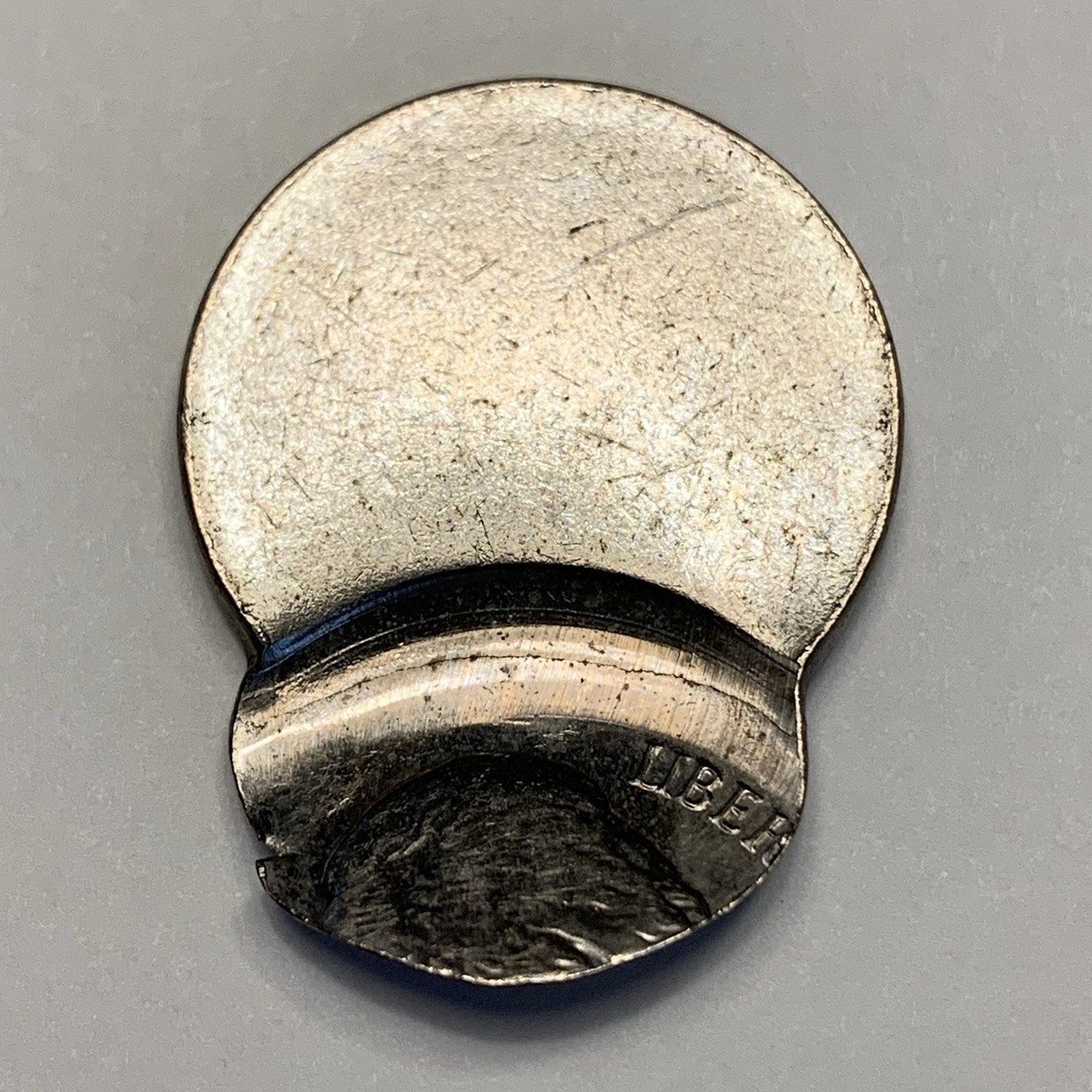
A broadstrike occurs when a planchet is struck by the dies outside the retaining collar that normally constrains the coin to its proper diameter. Without the collar's restraint, the metal spreads outward beyond the standard 21.2 mm boundary of a Jefferson nickel. The result is a coin that is visibly wider than normal, with a flat, unstacked rim and a slightly distorted design periphery.
On 1992 Jefferson nickel broadstrikes, the expanded planchet causes Jefferson's portrait and the peripheral lettering ("IN GOD WE TRUST," "LIBERTY," the date) to spread slightly outward. The reverse Monticello design similarly flattens at the edges. Despite the expansion, the design details in the center of the coin often remain sharp and well-defined. The most valuable broadstrikes show complete design with no clipping, strong central detail, and dramatic diameter expansion.
Broadstrikes are more common than double denominations but remain genuinely scarce compared to normally struck coins. Collectors focus on completeness — a broadstrike with all design elements fully visible and minimal post-mint damage commands the highest premiums. Values typically range from $30 to $100 for problem-free examples, with exceptional pieces featuring sharp detail and extreme expansion reaching above that range.
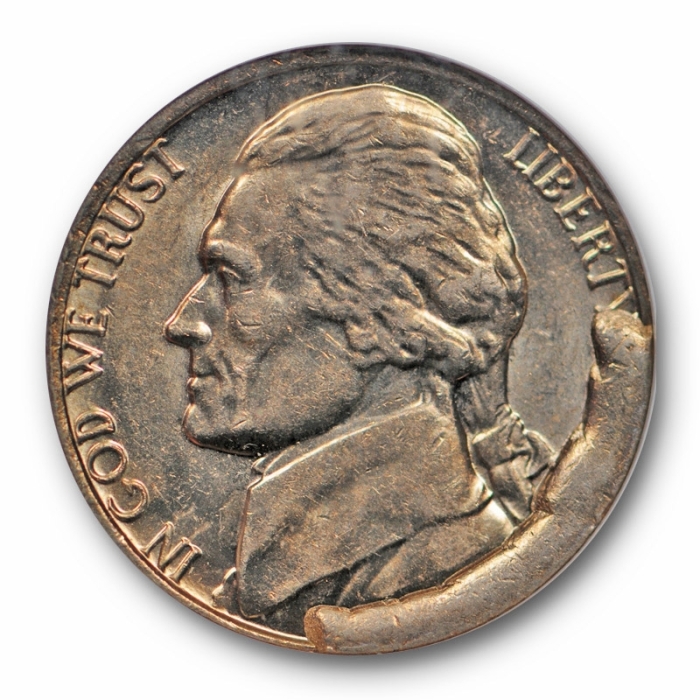
A die break error — commonly called a "cud" when it occurs at the coin's rim — forms when the hardened steel coining die develops a crack or fracture from the repeated stress of striking millions of planchets. Once the die cracks, the fractured section no longer strikes the coin normally; instead, it leaves a raised, irregular blob or line of metal on the coin's surface corresponding to the void in the die.
On 1992 Jefferson nickels, die breaks can appear on either the obverse or reverse. Rim cuds — where the break extends to the coin's edge — are the most visually dramatic and most valuable. Interior die breaks appear as raised lines crossing design elements. Both the Philadelphia and Denver mints produced documented die break examples in 1992, as high-production runs inevitably stress working dies to the breaking point.
Cud size directly correlates with value: larger cuds that obliterate design elements command higher premiums than small hairline cracks. A 1992-P nickel with a significant die break sold for $26 in a documented 2021 auction. Larger, more dramatic breaks in high-grade condition can bring $50 to $100 or more. Die breaks are permanent die states — each struck coin from that fractured die is identical, making them attributable varieties.
🔍 Think you've spotted one of these errors on your coin?
Run the Value Calculator →
| Mint | Mint Mark | Mintage | Purpose | Est. Survival Rate |
|---|---|---|---|---|
| Philadelphia | P | 399,552,000 | General circulation | Unknown (circulation) |
| Denver | D | 450,565,113 | General circulation | Unknown (circulation) |
| San Francisco | S | 4,176,560 | Proof sets (collectors only) | ~95% (~3,967,732) |
| Total | — | 854,293,673 | — | — |
Jefferson's hair details, cheekbone, and facial features show heavy smoothing. On the reverse, Monticello's columns, dome, and architectural details are flat. The steps at the base are completely merged or invisible. These coins are worth face value — no premium exists for worn 1992 nickels regardless of mint mark.
Moderate to light wear on Jefferson's highest relief areas — cheek, jaw, and hair above the ear. Monticello retains most architectural detail but the steps show some flatness or merging at the top lines. About Uncirculated (AU) pieces have only slight friction on the highest points. Value remains near face value for most circulated examples.
No wear whatsoever — original mint luster is present across the entire coin. Jefferson's portrait shows full hair strands and facial detail. Contact marks (from bag friction in mint storage) become the primary grade-limiting factor in this range. MS65 and above specimens have minimal marks and strong eye appeal. Value begins rising meaningfully here: $1.88–$16 range.
Nearly perfect surfaces with only trivial marks under magnification. Full original luster with vibrant cartwheel effect under rotating light. The critical additional factor: whether the Monticello steps show the Full Steps (FS) designation. MS66 without FS brings modest premiums; MS66 FS jumps to $38–$84. MS67 FS represents the pinnacle — only 7 total examples certified across both PCGS and NGC for the 1992-D.
🔍 CoinHix helps you match your coin's surface details against certified graded examples to narrow down the grade tier quickly — a coin identifier and value app.
The Full Steps (FS) designation is the single most important value multiplier for 1992 Jefferson nickels. Use this checker to see if your coin qualifies — before paying for professional grading.
The horizontal step lines at the base of Monticello are incomplete, blended together, or broken at one or more points. This is the typical outcome for most 1992 nickels, including many technically uncirculated specimens, because the step area is the deepest recessed part of the reverse die and is the first to show weakness in the strike. These coins are worth $1.88–$3.80 in MS condition.
Five or six complete, unbroken step lines run across the full width of Monticello's base — no interruptions, no merging, no breaks. This requires a fully-executed strike where the die pressure forced the planchet metal completely into the deepest recesses of the die. Full Steps coins from 1992 are genuinely scarce, and MS67 FS examples are among the rarest modern Jefferson nickels certified by PCGS or NGC.
The value calculator below factors in your mint mark, condition, Full Steps status, and any error varieties — giving you a specific estimated value range in seconds.
Use the Value Calculator →Select your coin's mint mark, condition, and any errors to get an estimated value range based on current auction and dealer data.
Not sure what grade or mint mark your coin has? There's a 1992 Jefferson Nickel Coin Value Checker online tool that lets you upload a photo of your coin and get an AI-assisted identification — a helpful first step if you're still learning the basics.
Describe what you see on your coin in plain language — grade indicators, any unusual features, mint mark, or anything that looks different from a typical nickel. The analyzer will match your description to known varieties and value drivers.
The right venue depends on your coin's grade and rarity. A raw (ungraded) MS65 is a different proposition than a PCGS-certified MS67 FS.
Best for certified MS67 FS examples and major errors like double denominations. Heritage reached the $3,760 record for the 1992-D MS67 FS. Minimum lots typically $200+; their numismatic team provides expert attribution. Expect 15–20% buyer's premium built into realized prices.
Ideal for mid-range certified coins (MS65 FS, MS66 FS) and authenticated error coins. Check recently sold prices for 1992 Jefferson nickels on eBay to calibrate your asking price before listing. Filter to "sold listings" to see actual transaction prices rather than wishful asking prices. PCGS or NGC slabs sell faster and for more than raw coins.
Good for quick liquidity on lower-grade specimens or bulk circulated material. Expect 50–70% of retail value — dealers need a margin to resell. Bring any certified coins in their holders; raw coins will be graded conservatively. Useful for getting an informed second opinion on whether a suspected error is genuine.
Active community marketplace for collector-to-collector sales. Good for raw MS65 or lower-end MS66 coins where slabbing costs would exceed the premium gained. Post clear photos under good lighting showing Monticello steps. Be prepared to answer questions about Full Steps status and any grading service population data.
The free calculator covers all three mint marks, Full Steps status, and five error varieties — results in under 10 seconds.
Use the Free Calculator Now →